

Last Updated on June 10, 2026
By Florian Smeritschnig, former McKinsey Senior Consultant · Updated June 2026
Yes, you can move from a Tier-2 firm to MBB, and you start from one of the strongest positions there is. If you are at Oliver Wyman, Kearney, L.E.K., Roland Berger, or Strategy&, you already do work that looks a lot like what McKinsey, BCG, and Bain do. The firms know it, and they hire laterally from your world every year.
That is exactly why this transition trips people up. Unlike a candidate switching in from a Big 4 advisory role, you are not fighting the assumption that you cannot do strategy. You clearly can. Your problem is subtler and, frankly, harder to fix: the offer comes down to the last 10%, the marginal sharpness that separates a strong Tier-2 case from an MBB pass, plus a “why MBB” answer that cannot just be “the brand is better.”
This guide is the one I wish every Tier-2 consultant had before applying. After coaching Tier-2 strategy consultants into all three MBB firms, the pattern is consistent. Here is what firms actually screen for when your skills are not in doubt, the specific gap you have to close, and how to tell a story that does not read as a prestige grab.
Key Takeaways
- Tier-2 to MBB is one of the most realistic transitions there is: you already do MBB-style strategy work, so capability is not the question.
- The real barrier is the last 10%: MBB’s case and interview bar is calibrated higher, and a strong Tier-2 performer can miss it by a notch.
- Expect the “why didn’t you make MBB the first time?” question. Most Tier-2 candidates were in the funnel before; firms want to know what has changed.
- The “why MBB” trap is brutal here. Because the work is so similar, “more prestige” or “better exit options” sinks the fit interview faster than for any other pool.
- The move is often a lateral, not a promotion. You may restart the clock at the same level, so the motivation has to be about the work, not the title.
- Your specific firm changes your pitch: Oliver Wyman, Kearney, L.E.K., and Strategy& each map to different MBB strengths.
What Counts as a Tier-2 Consulting Firm?
A Tier-2 consulting firm is a strategy-focused firm that sits one clear notch below MBB in brand and scale, while doing broadly comparable strategy work. The label is fuzzy and people argue about it, but the firms usually included are Oliver Wyman, Kearney, L.E.K. Consulting, Roland Berger, OC&C, and the Big 4-owned strategy arms: Strategy& (PwC), Monitor Deloitte, and EY-Parthenon, plus Accenture Strategy.
The distinction that matters for your transition is not the exact ranking. It is that your day-to-day work, structuring ambiguous business problems, building recommendations for senior clients, is the same kind of work MBB sells. That shared foundation is your advantage, and it is also why the bar for you is set where it is.
One note before we go further: if you are at a Big 4 strategy arm specifically, your move looks much more like this Tier-2 path than the classic Big 4 one, so you are in the right guide. If you are in Big 4 audit, tax, or core advisory, the Big 4 to MBB guide is the better fit, because you face a strategy-perception gap this article assumes you do not have.
The Tier-2 Advantage Most Candidates Waste
Start by being honest about how strong your hand is. When a recruiter compares you to the broader applicant pool, you arrive with things most candidates are still trying to fake:
- You can already case. You structure real problems for a living. The mechanics that take an undergrad two months to learn are muscle memory for you.
- You have client exposure. You have sat in front of executives, defended analysis, and lived through the messy middle of an engagement. That maturity shows in a fit interview.
- You speak the language. Hypotheses, drivers, MECE, “so what”, you do not have to translate your experience into business terms the way a candidate from outside consulting does.
Where Tier-2 candidates waste this advantage is by assuming it is enough. It is not. The very fact that you can clearly do the job raises the question the rest of this guide answers: if you are this good, why are you not already at MBB, and what is the actual gap? Coasting on “I’m basically already doing this” is the single most common way strong Tier-2 candidates underprepare and miss.
The Real Barrier: It’s Not Your Skills, It’s the Last 10%
Every applicant pool triggers one specific doubt in a calibration meeting. For ex-bankers it is “will they leave for private equity.” For Tier-2 candidates, the doubt is not about capability at all. It is a cluster of three concerns that only exist because you are already good.
1. “Can they clear our bar, or do they top out just below it?” MBB calibrates its case and interview standard a notch above most Tier-2 processes. A consultant who is genuinely strong at their firm can still land at “good, not exceptional” against the MBB rubric. The gap is not a missing skill; it is the final degree of sharpness in structuring, math under pressure, and synthesis. That is the last 10%, and it is the whole game.
2. “Why didn’t they make MBB the first time?” This one is specific to your pool. Most Tier-2 consultants were in the MBB funnel before, out of undergrad or business school, and did not get an offer. Recruiters quietly wonder what the original ding was, a school, a weak case, a missed bar, and whether it has been fixed. You have to pre-empt this, not hope it does not come up.
3. “Is this just a brand grab?” Because your current work is so close to MBB’s, the honest reason for moving is often prestige, exit options, or compensation. Those are exactly the answers that end a fit interview. The firm needs to believe you want something specific that MBB offers and your current firm does not, or it concludes you will jump again the moment a shinier logo appears.
When I coach Tier-2 candidates, the ones who get offers are the ones who stopped treating the case as a formality, closed the marginal gap deliberately, and built a “why MBB” story with a real answer underneath it.
Everything below is how.
The Last 10%: What Separates a Tier-2 Case From an MBB Offer
This is the most useful thing I do with a Tier-2 client: stop them practising the parts they already do well and target the specific degrees of sharpness MBB grades on. You are not relearning the case. You are closing a gap you may not even see, because at your firm “good” was good enough.
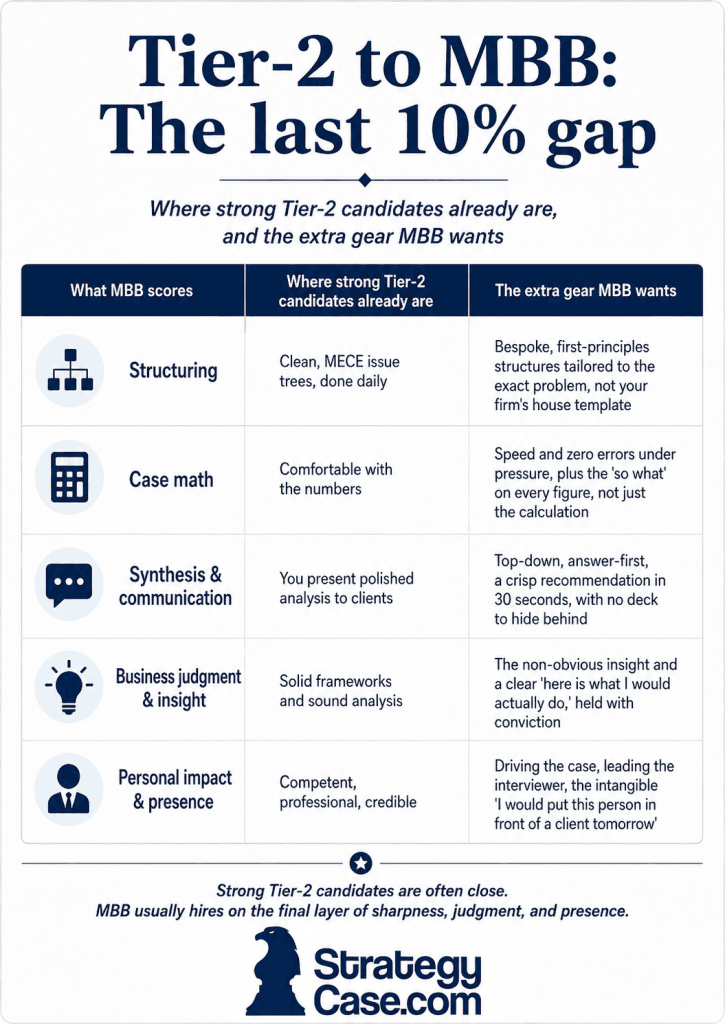
Read that table honestly against your last few cases. Most Tier-2 candidates are already at the left column on all five dimensions, which is why they assume they are ready. The offer lives in the right column. Work the comprehensive case interview guide for the method, and use the case interview frameworks guide to break the habit of dropping your firm’s standard structure, which is the single most common tell that you are “Tier-2 polished” rather than MBB-sharp.
Which Tier-2 Firm You’re At Changes Your Pitch
“Tier-2 to MBB” is not one transition. Where you sit shapes how a recruiter reads you and which MBB practice is your cleanest landing spot. Position to your firm’s strength rather than applying as a generic strategy lateral.
| Your firm | How MBB tends to read it | Your sharpest positioning |
|---|---|---|
| Oliver Wyman (esp. Financial Services) | Closest to MBB; the FS practice is genuinely elite | Lead with rigor; OW FS maps directly to MBB financial-institutions practices |
| Kearney | Strong operations and cost-transformation heritage | Operations, procurement, and performance-improvement angle |
| L.E.K. | Commercial due diligence, PE, life sciences | PE and commercial-DD work; a natural fit for Bain’s PE practice |
| Strategy& / Monitor Deloitte / EY-Parthenon | Generalist strategy, but Big 4-owned | Apply as a generalist; address the “is it real strategy” perception head-on |
| Roland Berger | European generalist strategy, industrials depth | Position by sector and region; strong for European MBB offices |
This also answers the comparison most Tier-2 candidates are quietly running in their heads, the “Oliver Wyman vs MBB” or “L.E.K. vs MBB” question. The gap is rarely the work itself; it is brand, scale of client, and the breadth of problems you get staffed on.
Name the specific thing the bigger platform gives you, and you have the start of a real “why MBB” answer.
The Level Question: Will You Move Sideways or Down?
Here is the part Tier-2 candidates underestimate. Moving to MBB is often a lateral, sometimes a half-step back, not a promotion. Your Tier-2 title usually maps fairly close to an MBB level, your reset is smaller than a Big 4 consultant’s, but you may still come in at the same rung and restart the promotion clock while you learn the firm’s way of working.
Two specifics to plan for:
- Tenure resets. A Manager at a Tier-2 firm does not automatically become a Manager at MBB. You may enter as an Associate or Consultant and re-earn the next promotion, because the firm wants to see you perform against its standard first.
- The pay math is usually still favorable. MBB compensation and the brand’s long-term exit value typically more than offset a nominal title step, and promotion cycles move quickly once you clear the bar. The McKinsey salary guide and the MBB salary guide have the level-by-level detail.
Decide now whether you can accept a lateral move for the platform. The candidates who struggle in interviews are often the ones quietly offended that MBB will not credit their seniority one-for-one. The ones who get offers treat the reset as the cost of the upgrade and move on.
Your “Why MBB” Story When You’re Already in Strategy
This is the question that decides Tier-2 offers, and it is harder for you than for almost anyone. You cannot fall back on “I want to get into strategy”, you are already in it. The interviewer is probing one thing: do you want something specific that MBB offers, or do you just want the logo?
Three answers that quietly kill the application:
- “MBB is more prestigious.” Even when it is the honest reason, it tells the firm you are chasing brand and will leave for the next one.
- “Better exit opportunities.” This signals you see MBB as a stepping stone out, not a place to do the work.
- “I’ve hit a ceiling at my firm.” Sounds like the problem might be you, and invites exactly the “why didn’t you make it before” doubt.
What works is an answer grounded in something your current firm structurally cannot give you:
The scale-and-breadth angle. “At my firm I do strong work, but on a defined band of clients and problem types. I want the scale of client and the breadth of industries that only the top platform staffs you on, the transformations, the board-level mandates, the global engagements that do not come through a boutique.”
The specific-capability angle. “Bain’s PE practice / McKinsey’s [specific practice] does exactly the work I want to go deep in, at a depth my firm cannot match. I am not leaving strategy; I am going to the place that does the version of it I care about.”
On the “why didn’t you make it the first time” question, do not dodge. Name what was missing then, less interview preparation, a different focus, a school filter, and show concretely what has changed. Owning it reads as maturity; ducking it confirms the doubt. For structuring these answers, use the consulting fit interview guide and the SCORE framework.
How to Close the Gap: Prep, Networking, and Timing
You do not need a beginner’s prep plan. You need a sharpening plan that targets the last 10% and nothing else.
- Prep against the MBB bar, not your comfort zone. Do not grind cases you already pass. Get feedback from someone who interviews at MBB standard and drill the specific gaps from the table above, first-principles structuring, fast clean math, answer-first synthesis. A handful of well-critiqued cases beats fifty comfortable ones.
- Use your network deliberately. Your single biggest asset is ex-colleagues who already made the jump. A referral from a current MBB consultant gets your CV read properly and signals you clear the bar. Use the consulting networking guide and how to get a referral for McKinsey, BCG, or Bain.
- Do not forget the screens. As an experienced hire you still sit the assessments, McKinsey’s Solve and BCG’s cognitive test. Build them into the timeline.
- Time it around two to four years in. Long enough to have real engagements and a promotion or strong reviews to point to, before you are so senior that the lateral reset stings or the “why move now” question gets harder.
Tighten your consulting resume to lead with decision-shaping impact and scale, and the StrategyCase team can pressure-test your application against what MBB screeners actually look for.
FAQ: Tier-2 to MBB
Is it worth moving from Tier-2 to MBB?
For most people, yes, if you want the bigger platform. MBB offers larger clients, broader problems, stronger long-term brand, and faster compensation growth. The trade-off is a likely lateral or slight title reset and a higher-pressure environment. If your only motivation is prestige, the move is rarely worth the upheaval, and it will show in your interviews.
Why is the case interview harder moving from Tier-2 to MBB?
The skills are the same, but MBB calibrates the bar a notch higher. A case that passes at a Tier-2 firm can land at “good, not exceptional” against the MBB rubric. The gap is the last 10%: bespoke structuring, faster error-free math, sharper answer-first synthesis, and clear, conviction-led recommendations.
Will I have to start at a lower level at MBB?
Often it is a lateral rather than a promotion, and sometimes a half-step back. A Tier-2 Manager may enter as an MBB Associate or Consultant and re-earn the next promotion. Your reset is usually smaller than a Big 4 consultant’s, and the pay and brand typically more than offset the nominal title change.
Does it hurt my application that I didn’t get an MBB offer the first time?
Only if you do not address it. Most Tier-2 candidates were in the MBB funnel before, so firms expect it. Name what was missing then and show what has changed since. Owning the gap reads as maturity; avoiding the topic confirms the doubt.
How does Oliver Wyman, L.E.K., or Roland Berger compare to MBB?
All do genuinely strong strategy work; the gap is brand, client scale, and breadth of problems rather than the quality of the work. Oliver Wyman’s financial-services practice is closest to MBB, L.E.K. is strong in PE and commercial due diligence, and Roland Berger is a European generalist powerhouse. Position to your firm’s specific strength when you apply.
How long should I stay at a Tier-2 firm before moving to MBB?
Usually two to four years. That gives you real engagements and a promotion or strong reviews to point to, while keeping the lateral reset and the “why move now” question manageable. Earlier is fine if you are already clearing the bar; much later makes the title reset harder to accept.
Related Guides
- Big 4 to MBB: the right guide if you are in Big 4 audit, tax, or core advisory, where the barrier is proving you do strategy at all (not the case-sharpness gap this guide covers).
- Investment banking to consulting: if you are weighing a finance-to-strategy move or targeting PE and corporate-finance practices.
- Non-traditional background to consulting: the umbrella guide for candidates without a strategy pedigree.
- How to get into consulting: the application and recruiting article that sits above this guide.
The Bottom Line
Moving from Tier-2 to MBB is not a question of whether you can do the work. You can; the firms know it; that is why you start ahead. The offer turns on the things your competence hides: the last 10% of case sharpness, a clean answer to why you did not make it the first time, and a “why MBB” story that is about the work rather than the brand.
That is exactly what StrategyCase helps Tier-2 consultants do. The Case Interview Academy and Fit Interview Masterclass were built by former MBB interviewers to target the MBB bar specifically, and 1-on-1 coaching with Florian gives boutique-strategy consultants direct feedback on the exact gaps in this guide. A real share of the people I coach come from Tier-2 firms; this playbook is what we work through together.
Close the last 10%, fix the story, and the brand on your badge stops being the thing holding you back. Book a free StrategyCase consultation and we will pressure-test your profile and map the fastest route from your boutique to an MBB offer.

