
By Florian Smeritschnig, former McKinsey Senior Consultant · Updated June 2026
The McKinsey phone interview is a roughly 30-minute screening call, by phone or video, that some offices and roles use before the main interview rounds. It comes in two formats: a condensed phone case interview, usually run by HR or a firm alumnus, and a rapid-fire personal fit screening. Candidates and recruiters also call it the phone screen, the screening call, or the recruiter screening call; it is the same step.
The single most useful thing to do when the invite lands: ask your recruiting contact whether the call covers a case or fit. Offices differ, and walking into a case unprepared because you expected a resume chat is the most avoidable way to end a McKinsey process early.
After leaving McKinsey, I have coached many candidates through McKinsey’s process, including these screens, and this guide covers both formats: what is asked, who evaluates you, where the call sits in the full process, and how to pass it.
Key Takeaways
- The McKinsey phone screen runs about 30 minutes and is either a condensed case interview or a quick fit screening. Ask your recruiter which one you will face.
- The phone screen is not very common. If you go through it, it is usually run by HR or an alumnus who takes written notes; a consultant later decides on those notes alone. Your structure has to survive transcription.
- Expect three case question types: structuring, math, and occasionally exhibit interpretation, in McKinsey’s interviewer-led style.
- You do not need a perfect call. McKinsey looks for spikes plus no major weakness; a small math slip with strong structuring routinely passes.
- Most “phone” interviews now run as video calls; test your setup, but prepare for audio-only as the worst case.
What is the McKinsey phone interview?
The McKinsey phone interview is a preliminary screening step that certain offices and roles use to filter candidates before the in-person or video interview rounds. McKinsey tells you in the invitation that a screen is coming, but often not which format, which is why you ask.
| Phone screen logistics | What to expect |
|---|---|
| Length | About 30 minutes, with a short intro |
| Medium | Phone or video call; video is now the default in most offices |
| Other names | Phone screen, screening call, recruiter screening call, introductory call |
| Two formats | Condensed case interview OR rapid-fire fit screening |
| Who runs it | HR or a firm alumnus for case screens; a recruiter for fit screens |
| Who decides | A consultant, reading the screener’s written notes |
| Who gets it | Office- and role-dependent; common for experienced hires and high-volume intakes |
That second-to-last row is the detail that should shape your entire preparation, and almost nobody exploits it. The person on the call is often not the person who decides. The screener records your answers in writing and forwards their notes to a consultant, who makes the pass/fail call from the notes alone.
A note-taker cannot transcribe charisma. They can transcribe “three numbered drivers, a hypothesis, and a correct calculation.” On a phone screen, structure is not just good practice; it is the only part of your performance that reliably reaches the decision-maker.
Where the phone screen sits in McKinsey’s process
The screen is an early gate, not an interview round. For most candidates who face one, the sequence looks like this:
- Application (resume and cover letter) through the McKinsey application process, submitted via mckinsey.com/careers
- Phone or video screen (this article), where the office uses one (sometimes also after the Solve to discuss logistics and fit)
- McKinsey Solve, the digital assessment, where the role requires it
- First-round interviews: cases plus the Personal Experience Interviews (PEI)
- Final-round interviews with partners, then the decision
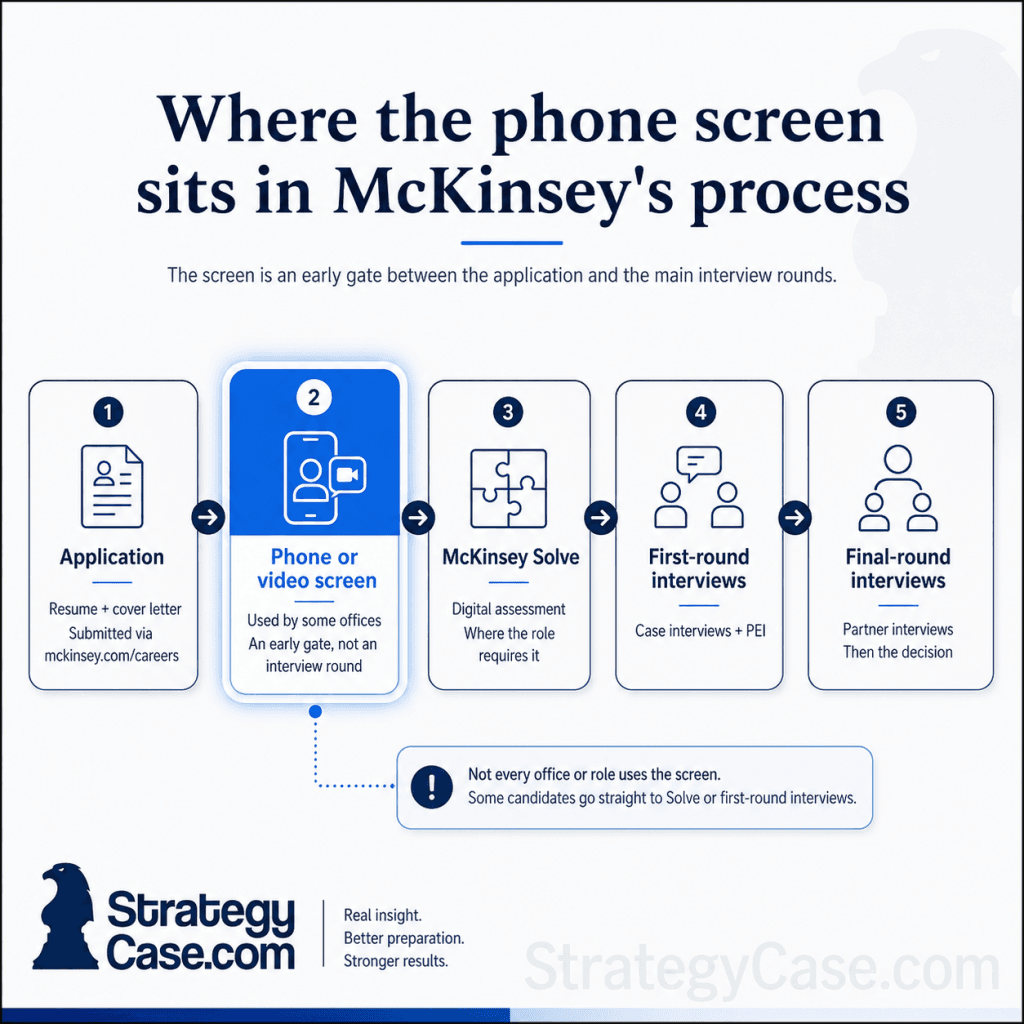
However, not every office or role uses the screen. If you never get one and go straight to Solve or first-round interviews, nothing is wrong; the office skips this gate for your role (which they do in most cases). McKinsey describes the overall loop on its careers page.
The McKinsey phone case interview
The phone case is a condensed McKinsey case: about 15 minutes (plus extra time for other topics), interviewer-led, run by HR or an alumnus rather than a consultant. It compresses the standard question categories into a shorter, simpler scenario, with less depth than an in-person case but the same scoring logic.
You will typically face three question types:
- Structuring, including brainstorming: “What factors would you look at to investigate the decrease in customer satisfaction?”
- Math: a calculation set up from case data, where the approach counts as much as the number
- Exhibit interpretation, less common by phone for obvious reasons, more likely on video
For structuring and exhibits there is no single right answer. Strong answers are deep, broad, insightful, hypothesis-driven, and communicated top-down in MECE buckets. For math there usually is a correct answer, with reasonable rounding accepted; the screener checks both your approach and your calculation.
Do not expect a cookie-cutter scenario a memorized framework will solve; McKinsey’s screens follow the same philosophy as its main cases, where memorized frameworks fail. The cases are simpler, the bar per question lower, but the style is identical.
How the phone case is scored
The overall picture counts, not perfection per question. McKinsey looks for spikes in some areas and good-enough performance everywhere else. The most common pattern I see: strong structuring and exhibit work, one small slip in math, roughly an 80% performance, and a pass to the next round. A weak performance across the board fails even without a single big mistake.
Performance tips for the phone case
Phone and video strip out the cues that carry an in-person case, so the burden shifts entirely to your words:
- Signpost everything. “I see three drivers; the first is…” replaces the eye contact and hand gestures the screener cannot see, and it gives the note-taker numbered points to write down.
- Outline before you answer. State your approach in one sentence, then fill it in. On the phone, an unstructured answer sounds twice as chaotic as it would in a room.
- Narrate your math. Walk through the setup out loud before calculating, so the approach is on record even if you slip on a number, and sanity-check the result before presenting it.
- Close top-down. Lead the recommendation with the answer, then two or three supporting points, then one risk. Decisive but honest about assumptions.
The McKinsey phone fit interview
The second format is a fit screening: about 15-30 minutes of rapid-fire, high-level questions. It is a breadth check of your motivation and communication, not a deep look at one story the way the Personal Experience Interview (PEI) is. Expect questions like:
- “Guide me through your resume”, your professional story in two to three minutes
- “Why consulting?” and “Why McKinsey?”, your motivation, with reasons specific to the firm
- “Are you aware of the work we are doing in [specific practice], and how could you contribute with your experience?”, a staple for experienced hires
Prepare a structured, top-down answer for each: lead with the headline, then 3 to 5 key points that connect your experience to what a McKinsey consultant actually does. The screener is writing these down too; give them clean bullets, not a stream of consciousness. Rapid-fire does not mean low stakes: a screen-stage rejection ends the process exactly as finally as a final-round one.
The McKinsey phone screen is more likely to include a fit interview than a case interview. For the fit interview, there will also not be any consultant looking over the interviewer’s notes. It’s purely HR-driven.
Additionally, this interview is a great opportunity to discuss your own questions and interview logistics moving forward.
Phone and video setup: the 5-minute checklist
Logistics will not win you the screen, but they can lose it. Before the call:
- Room: quiet, no interruptions; tell the people around you the slot is blocked
- Connection: wired or strong Wi-Fi; phone fully charged; the meeting software tested with a trial call
- Audio: headphones with a microphone beat laptop speakers; do a recording test
- Video (if applicable): camera at eye level, light source in front of your face, tidy background
- On the desk: paper, pen, calculator within reach, your resume printed, water
One phone-specific habit worth practicing: structuring on paper while talking, without the visual contact that normally buys you a pause. Run at least one full mock by phone or video before the real call; it feels different from across-the-table practice, and you want the awkwardness spent before it counts.
After the phone interview: what happens next
McKinsey typically communicates the outcome within a few days to a week. A short delay usually means batching across candidates, not a problem; following up politely after a week is fine.
If you pass, prepare for the real rounds: full-length cases with consultants, the PEI, and deeper fit conversations. The screen’s evaluation logic carries forward, problem-solving, communication, leadership potential, and fit with the firm’s values, just with a higher bar and consultants instead of screeners across the table. If they offer feedback, take it literally; it previews what the next round will probe.
Ace your McKinsey interviews with StrategyCase
The phone screen is the warm-up; the rounds that follow are where offers are won. The StrategyCase Fit Interview Masterclass is a 5-hour video course covering what McKinsey interviewers evaluate, proven answer structures for every fit and PEI question, and the mistakes that cost candidates offers.
Frequently asked questions
Is the McKinsey phone screen a real interview or just a logistics call?
A real, scored interview. It is either a condensed case interview (rare) or a rapid-fire fit screening. Some calls also cover logistics for later rounds, but treat every minute as evaluated.
How long is the McKinsey phone interview?
About 15-30 minutes, including a short introduction. Case screens spend nearly all of it on the case; fit screens move quickly through several motivation and resume questions, then discuss interview logistics and your own questions.
Is the McKinsey phone screen with a recruiter or a consultant?
Usually HR, a recruiter, or a firm alumnus, not a consultant. For the case, they record your answers in writing, and a consultant makes the pass decision from those notes, which is why clearly structured, numbered answers matter more here than anywhere else in the process.
What questions are asked in a McKinsey phone interview?
Case screens ask structuring, math, and occasionally exhibit questions from one condensed business scenario. Fit screens ask resume walkthroughs, “Why consulting?”, “Why McKinsey?”, and, for experienced hires, practice-specific questions about where you would contribute.
Is the McKinsey phone interview actually by phone or by video?
Most offices now run it as a video call, though audio-only still happens. Prepare for both: test your video setup, and practice at least one mock without visual contact, because structuring out loud with no facial feedback is the part that surprises candidates.
Does everyone interviewing at McKinsey get a phone screen?
No, most people don’t. Offices and roles use it selectively, often for experienced hires or high-volume intakes. Going straight to the Solve assessment or first-round interviews without a screen is completely normal. In some cases, the phone screen takes place after the Solve game.
Related guides
- How long to prepare for consulting interviews: realistic timelines from screen to final round
- McKinsey Values and Purpose Interview: the values conversation some offices add to the loop
- McKinsey Keep in Touch program: what happens if this attempt does not land
- McKinsey salary and hierarchy: what is waiting at the end of the process
Final word
The McKinsey phone interview is the cheapest place in the whole process to get eliminated, and the easiest gate to prepare for once you know the rules. Ask your recruiter whether it is case or fit. Prepare that format properly. And structure every answer so it survives being written down by a note-taker and judged by a consultant who never heard your voice. Clear the screen, and you have earned the interviews that actually decide your offer.
For the rounds that follow, start with the StrategyCase Fit Interview Masterclass and prepare your stories with the same structure you brought to the screen.
About the author: Florian Smeritschnig is a former McKinsey Senior Consultant and the founder of StrategyCase. He spent five years at the firm, evaluated candidates, and has since run more than 2,200 mock interviews and coached hundreds of candidates into McKinsey, BCG, Bain, and other top firms.
