

Last Updated on June 15, 2026
By Florian Smeritschnig, former McKinsey Senior Consultant · Updated June 12, 2026
A second-round case interview is the final, partner-led round of consulting recruiting, and it is not harder than your first round. The case standards, the skills tested, and the evaluation criteria stay the same. What changes is who sits across from you, what they pay attention to, and how predictable the conversation is.
Most candidates get this exactly backwards. They pass round one, skip the celebration, and start grinding harder cases for a “final boss” that does not exist. Then they walk in tense and underperform in a round that mostly exists to confirm what round one already showed. I spent five years at McKinsey, evaluated candidates there, and have since coached 700+ offers through StrategyCase.
The verdict from that side of the table: if you were good enough to pass round one, you already meet the bar for round two. Your job between rounds is to fix the specific weaknesses your first-round interviewers flagged, not to relearn casing.
Key Takeaways
- At most McKinsey, BCG, and Bain offices, the second round is the final round, run by partners and senior partners.
- The cases are not harder. The skills and the evaluation sheet are the same as in round one; the seniority, the focus, and the structure of the interview are what change.
- Partners read your first-round feedback before they meet you. They probe flagged weaknesses, so ask recruiting for that feedback and fix the specific gap.
- Expect less predictability: rapid-fire structuring questions, improvised cases, heavy pushback, or a casual conversation are all normal partner behaviors.
- Spend the days between rounds on your flagged weakness and on top-down synthesis, not on 20 new full-length cases.
What is a second-round case interview?
A second-round case interview is a case interview in the final round of a consulting firm’s recruiting process, usually run by partners and senior partners. You solve the same style of business case as in round one, but the interviewers now focus on confirming your first-round performance, testing flagged weaknesses, and deciding whether they would put you in front of a client.
The naming trips people up. At most MBB offices, “second round,” “final round,” and “partner round” describe the same thing, because the standard process has two interview rounds. Some offices add a third round, experienced hires often face extra conversations, and Big 4 and Tier-2 firms frequently run three or more rounds.
The mechanics in this guide apply to whichever round of yours the partners run. If you need a refresher on how cases work in any round, start with our complete case interview guide.
First vs. second round: what actually changes
Strip away the forum mythology and the differences come down to a short list. This is the comparison I walk clients through after every passed first round.
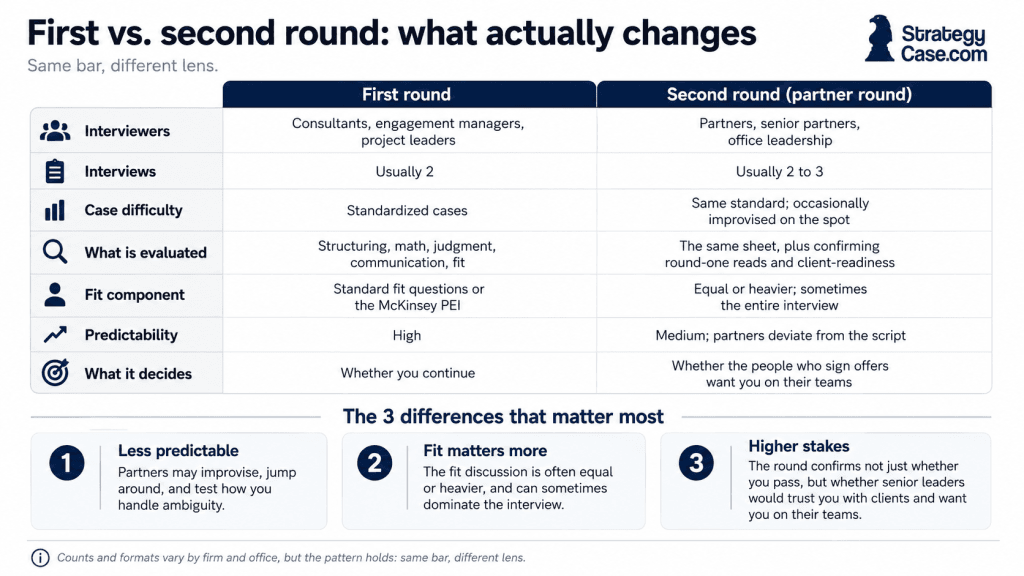
Counts and formats vary by firm and office, but the pattern holds: same bar, different lens. Three of those differences deserve a closer look, because they are the ones that change how you should prepare.
The seniority of the interviewers
First rounds are mostly run by people one to six years into the firm. Final rounds are run by the firm’s owners. That gap is real, but it changes the room’s atmosphere more than the room’s difficulty.
A partner across the table plays with your nerves even though the case is just as easy or hard as last time. Your read of “this round was brutal” is usually an interpretation of the situation, not the content. The horror stories you read online suffer from the same distortion: candidates who hit an unusual partner round post about it; the majority who got a standard interview never write a word. In my experience evaluating candidates at McKinsey and running 2,200+ coaching sessions since, roughly 95% of partner rounds run on the same standardized format as round one.
Partners read your first-round feedback before they meet you
Here is the part of the process candidates consistently underestimate. Your final-round interviewers do not walk in blind. They have your first-round evaluations in front of them, and they use the interview to confirm strengths or stress-test doubts your previous interviewers raised.
If round one flagged your math (“I want to see more initiative and shortcuts in the quantitative sections”), expect the partner’s case to lean quantitative. If your structuring wobbled, expect a prompt that forces you to build a framework from scratch. This is why the single highest-value move between rounds is asking your recruiting coordinator for detailed first-round feedback, including concrete examples.
The more specific the feedback, the more targeted your remaining preparation. The skills being scored have not changed, so the fix is rarely “do more cases.” It is “repair this one dimension.”
The structure gets looser
The last consistent difference: final rounds are less scripted. Interview guidelines on format, questions, length, and evaluation criteria still exist, but senior partners have the standing to run the conversation their own way. Concretely, a partner might:
- Drill one specific skill, such as structuring or brainstorming, for the entire session to verify a first-round read
- Fire a series of short, unrelated case questions instead of one full case
- Improvise a case from a client situation they worked on that month
- Push back hard on your answers to see whether you defend your position or fold
- Skip deep fit stories and probe general motivation instead, or do the reverse and spend the hour on your fit stories and personal experience
- Run the whole meeting as a relaxed conversation because your file already convinced them
Two real examples from my coaching work. One client faced eight consecutive structuring and brainstorming questions in a single final round, with the partner challenging every answer he gave. Another client prepared sharp case skills and fit stories, and then her final-round interviewer, the office’s managing partner, asked only about her life outside work; the conversation never got past her musical interests.
Both walked out convinced they had failed.
Both got the offer.
Why partner rounds are not harder than round one
The myth that the final round is the hardest filter does not survive contact with how firms actually run it. Several structural factors work in your favor:
- You know the format. Round one removed the unknowns: you know the case rhythm, the fit questions, and the building. Familiarity lowers the real difficulty even if your nerves disagree.
- You know where you stand. First-round feedback, whether delivered or requested, tells you exactly what to repair. No other stage of the process gives you that clarity.
- You know the firm better. Office visits, interviewer small talk, and round one itself give you material to connect with partners as people, not titles.
- The fit share grows. Partners spend more of the session on fit and motivation, which well-prepared candidates can control far more reliably than a cold case.
- The firm wants to close you. By the final round, the firm has invested screening tests, four-plus interviewer hours, and coordination in you. Partners are not hunting for reasons to reject; they are confirming a hire.
The honest caveat: “not harder” does not mean “guaranteed.” Firms do not publish round-by-round pass rates, and anyone quoting an exact number is guessing. Across my own experience, somewhere between a third and half of final-round candidates convert to an offer, with big swings by office, season, and hiring appetite.
Compare that with the roughly 1 in 100 applicants who make it through the full funnel, and the final round is statistically the friendliest stage of the entire process.
McKinsey, BCG, and Bain: how second rounds differ by firm
The search data behind this article tells me most of you are not asking “what is a second round” in the abstract. You want to know what changes at your firm. The short version, office variation included:
| McKinsey | BCG | Bain | |
|---|---|---|---|
| Typical final round | 2 to 3 partner interviews | 2 to 3 interviews with partners or MDPs | 2 to 3 interviews with managers and partners |
| Each interview contains | PEI + interviewer-led case | Candidate-led case + conversational fit | Answer-first case + structured fit |
| Standardization | Very high; ~95% run to script | Moderate; partner discretion is common | Moderate; office-dependent |
| Wildcard to expect | Deeper PEI probing | Improvised cases from live client work; some written cases | A written case in some offices |
McKinsey second round
McKinsey runs the most standardized final round of the three. Expect two to three partner interviews, each pairing a Personal Experience Interview with an interviewer-led case, exactly the structure described in the McKinsey case interview guide. Partners dig deeper on the PEI follow-ups and expect crisper synthesis, and the firm’s own interviewing page confirms the format stays consistent across rounds.
BCG second round
BCG gives partners more room to freestyle. The case remains candidate-led, as described in BCG’s official interview preparation guidance, but final-round partners more frequently improvise cases from their own client work and push harder on your business judgment. For more, see our BCG case interview guide. A few offices still use a written case format in late rounds; if yours does, our written case interview guide covers it.
Bain second round
Bain final rounds stay close to the first-round format, with the firm’s answer-first approach even more visible: partners want a hypothesis early and a top-down recommendation at the end. Several Bain offices, especially in Europe, add a written case presentation to the final round, and Bain’s hiring process page outlines the stages each office uses.
One note for experienced hires across all three firms: your partner round leans harder into commercial judgment and client-readiness, because the firm is deciding whether it can staff you senior from day one. The dynamics are covered in our experienced-hire guide for McKinsey, BCG, and Bain.
How to prepare between round one and round two
You will usually have between two days and two weeks between rounds. Most candidates waste that window grinding new full-length cases, which trains nothing they were not already doing. Run a targeted plan instead. Here is the between-rounds plan I use with coaching clients, compressed into the days you actually have:
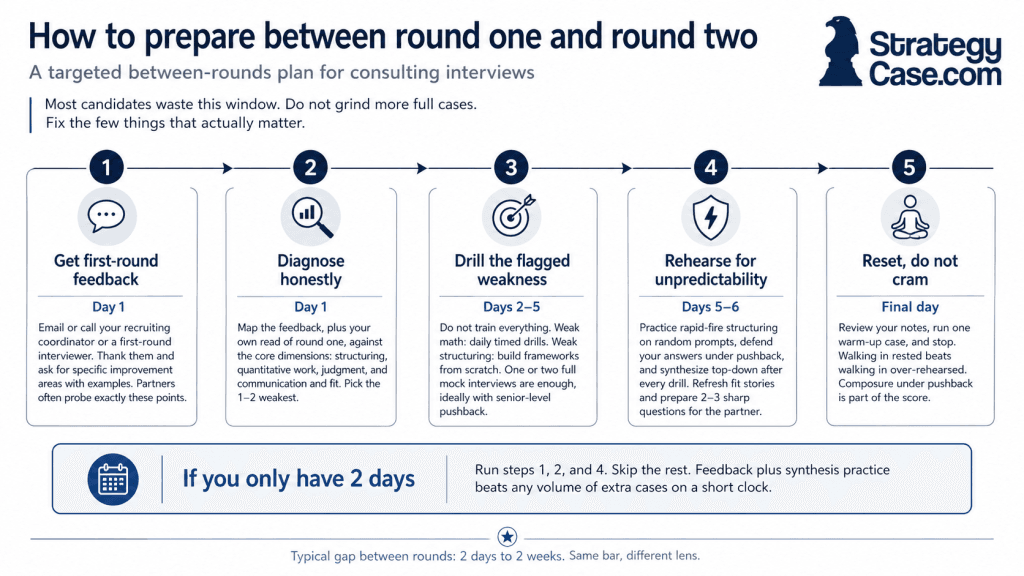
- Get your first-round feedback (day 1). Email or call your recruiting coordinator or one of your first-round interviewers, thank them, and ask for specific improvement areas with examples. Most firms share more than candidates expect, and partners will probe exactly these points.
- Diagnose honestly (day 1). Map the feedback, plus your own read of round one, onto the dimensions firms score: structuring, quantitative work, judgment, and communication and fit. Pick the one or two weakest.
- Drill the flagged weakness, not everything (days 2 to 5). Weak math gets daily drills under time pressure; wobbly structuring gets framework-building reps from scratch. One or two full mock interviews are plenty, ideally with someone senior enough to simulate partner-style pushback. This is the exact situation 1-on-1 coaching with a former McKinsey interviewer is built for.
- Rehearse for unpredictability (days 5 to 6). Practice rapid-fire structuring on random prompts, defend answers against deliberate pushback, and force yourself to synthesize top-down after every drill. Refresh your fit stories and prepare two or three sharp questions to ask the partner; partners notice the quality of your questions more than junior interviewers do.
- Reset, do not cram (final day). Review your notes, run one warm-up case, and stop. Walking in rested beats walking in over-rehearsed, because composure under a partner’s pushback is part of what they are scoring.
If your rounds are only two days apart, run steps 1, 2, and 4 and skip the rest. Feedback plus synthesis practice beats any volume of extra cases on a short clock.
Frequently asked questions
Are second-round case interviews harder than first-round interviews?
No. The cases follow the same standards and the same evaluation criteria as round one. The round feels harder because partners conduct it and deviate from the script more often, but the bar you must clear is unchanged. Candidates who pass round one already operate at that bar.
What is the pass rate for final-round consulting interviews?
Firms do not publish round-by-round pass rates, so treat any exact figure as invented. Based on my experience, roughly a third to half of final-round candidates receive an offer, with wide variation by office and hiring season. Your odds in the final round are dramatically better than the 1-in-100 overall applicant funnel.
How much time do you get between the first and second round?
Typically anywhere from two days to two weeks, depending on the office’s interview calendar and partner availability. Some offices schedule both rounds in the same week. Use whatever window you get on first-round feedback and targeted weakness repair rather than new full-length cases.
Do partners see your first-round feedback?
Yes. Final-round interviewers review the written evaluations from your first round before meeting you, and they often design their session to confirm strengths or stress-test the doubts noted there. That is why requesting your own feedback from recruiting is the highest-value preparation step between rounds.
Is the second round always the final round?
At most McKinsey, BCG, and Bain offices, yes: two rounds is the standard process, so round two is the decision round. Some offices add a third round, experienced hires often get extra conversations, and Big 4 and Tier-2 firms commonly run three or more rounds.
Should I prepare new frameworks for the partner round?
No. Partners test the same structuring skill with less predictable prompts, so memorizing new templates points your effort in the wrong direction. Practice building structures from scratch on unfamiliar problems and defending them under pushback. That flexibility is what the looser partner format actually rewards.
Related guides
- Case interview frameworks: build structures partners cannot shake
- Case interview math: the most commonly flagged first-round weakness
- Brainstorming in case interviews: the partner-round favorite drill
- Case interview examples: practice material for your between-rounds mocks
Final word
The second-round case interview is the friendliest hurdle left between you and the offer: the same bar you already cleared, judged by the people with the authority to say yes. Get your first-round feedback, repair the one or two flagged weaknesses, rehearse for a looser conversation, and treat the partner as a future colleague rather than a final boss.
If you want a structured path through exactly this preparation, StrategyCase’s Case Interview Academy was designed by former MBB interviewers around the criteria partners actually score: first-principles structuring, sharp synthesis, and executive communication. It is the program I point every between-rounds client to first.
About the author: Florian Smeritschnig is a former McKinsey Senior Consultant and the founder of StrategyCase. He spent five years at the firm, evaluated candidates at McKinsey, and has since delivered 2,200+ mock interviews and coaching sessions, helping hundreds of candidates land offers at McKinsey, BCG, Bain, and other top firms.
