
By Florian Smeritschnig, former McKinsey Senior Consultant · Updated June 2026
A case interview is a job interview, used by consulting firms like McKinsey, BCG, and Bain, in which you solve a realistic business problem out loud while the interviewer scores your structuring, problem-solving, analytics, math, business judgment, and communication. A single case runs about 20 to 40 minutes, and you typically face four to six of them across two rounds before an offer. Tech companies, private equity funds, and even non-profits now use the same format to test how you think.
I spent five years at McKinsey as a Senior Consultant, sat on the other side of the recruiting table, and have since run more than 2,200 mock cases with people targeting top firms. Here is the blunt truth most prep gets wrong: the offer is usually decided in the first few minutes of a case, when you lay out your structure, not in the 90% of prep time candidates spend grinding old practice cases. This guide shows you what a case interview actually is, the five elements every case tests, what your interviewer is really writing down, and how to prepare without wasting weeks on the wrong things.
Key Takeaways
- A case interview asks you to solve a real business problem out loud; firms use it because it mirrors the actual job of a consultant.
- Every case moves through five core elements: structuring frameworks, charts, math, brainstorming, and a recommendation. Each tests a set of different skills.
- Interviewers score these skills on a 1-to-5 scale. You need clear strengths and no major weakness, not a flat “good” everywhere.
- Case types are misleading. Real cases are hybrids and wildcard, so a memorized “profitability framework” is the fastest way to look like a candidate who pattern-matches instead of thinks.
- Fewer than 1 in 100 applicants gets an offer. The ones who pass are the most structured and best prepared, not the smartest in the room.
What is a case interview?
A case interview is a 20-to-40-minute job interview in which the candidate solves a realistic business problem out loud, working toward a recommendation while the interviewer assesses their structuring, analytics, quantitative reasoning, business judgment, and communication.
Consulting firms use it because it simulates the job. A consultant’s week is spent breaking ambiguous client problems into pieces, doing the analysis, and recommending an action. The case interview compresses that into half an hour. McKinsey, BCG, and Bain run the most rigorous versions, but Big 4 firms, Tier-2 strategy houses, tech companies, and PE funds all use cases now, which is why the skill transfers far beyond MBB.
You will usually face the case alongside a fit interview, the behavioral half of the loop, in the same session. Treat them as one loop, because firms score both and a strong case never rescues a weak fit.
What actually happens in a case interview
The interviewer opens with a prompt. It is usually a short paragraph describing a client and a problem or question they want to have answered and a one or two sentence objective. Two shortened real examples of the kind of opener you will hear:
- “Our client is a European tour operator whose profits have fallen 30% in two years. They want to know why, and what to do about it.”
- “A national government wants to improve education outcomes without raising its budget. How should it go about it?”
From there, almost every case follows the same arc, whether it is a MBB case or a Tier-2 one:
- Clarify the problem and confirm the objective. Repeat it back so you are solving the right question.
- Structure the problem into a few logical, prioritized buckets before you dive in.
- Form a hypothesis about where the answer likely sits, then ask for the data to test it.
- Analyze exhibits and run the math, narrating your logic as you go.
- Synthesize as you learn, updating your thinking at each step.
- Deliver a recommendation, top-down, with the key supporting arguments and next steps.
The whole thing is a conversation, not a monologue. The interviewer feeds you information, redirects you, and probes your reasoning throughout.
The 5 core elements every case tests
Strip away the industry and the story, and every case interview is built from the same five elements. This is the anatomy I teach first, because once you can see the parts, the cases stop feeling random. Each element exists to test specific skills.
| Core element | What it really tests | What a strong candidate does |
|---|---|---|
| Structuring | Logical, MECE problem-solving | Builds a custom, prioritized tree for this prompt and says where to start |
| Exhibits and charts | Analytical thinking | Interprets a chart fast, pulls the “so what,” ignores the noise |
| Math | Quantitative reasoning under pressure | Sets up the calculation out loud, quickly calculates, sanity-checks the result, interprets it |
| Brainstorming | Creativity and business sense | Generates structured, non-obvious ideas, not a random list |
| Recommendation | Synthesis and communication | Leads with the answer, backs it with the analysis, names the next steps (for some firms, risks) |
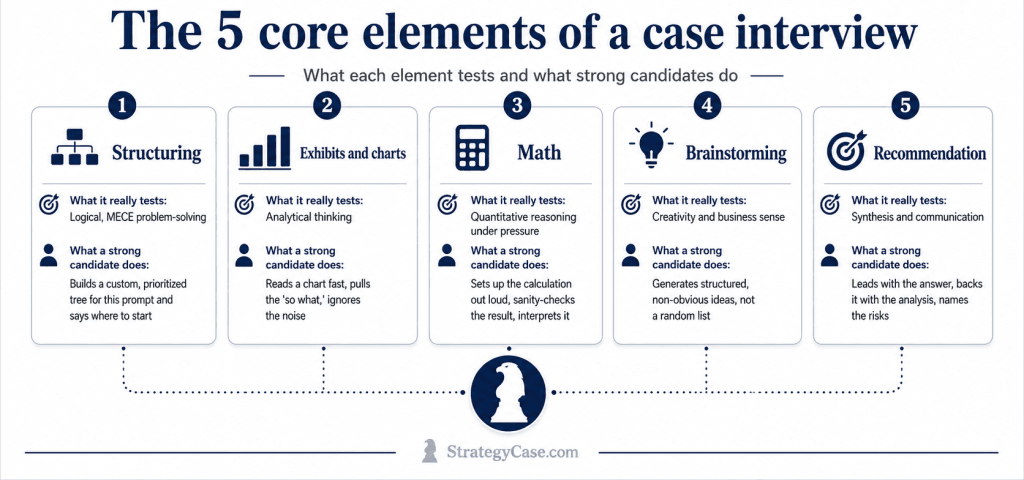
Each element is a piece of the puzzle you can train on its own. We have dedicated guides for case interview frameworks and structuring, chart and exhibit interpretation, case interview math, and brainstorming in a case. Train them separately through our guides and drills, then stitch them together in full cases.
How the five elements come together: a worked example
Elements in a table look tidy. A real case is messier, because the five elements interleave and you have to switch between them on the fly. Here is how a single case actually flows.
The prompt: a premium headphone manufacturer has seen sales drop 40% in 18 months and wants to know why.
- Structuring. You do not reach for a generic “profitability framework.” You build a framework specific to this client and this situation. First, you quantify the decline: how much of the sales drop comes from volume versus price, and where exactly it shows up across products, regions, customer segments, and channels. This tells you whether you are dealing with a broad-based business issue or a concentrated pocket of decline. Second, you diagnose the drivers. On the external side, you would test market demand, competitor moves, new substitutes, and customer preference shifts. On the company side, you would test pricing, distribution, marketing effectiveness, product competitiveness, availability, and manufacturing or quality issues. Given that sales dropped by 40% in only 18 months, you would prioritize sharp, disruptive explanations first, especially competitive entry, channel disruption, or a major product gap, rather than slow-moving macro or category decline.
- Hypothesis. You commit to a testable view instead of staying abstract: “My initial hypothesis is that the client is losing volume because a competitor launched a cheaper wireless substitute that better matches customer preferences. I would test this by comparing our unit sales, price levels, product features, and channel performance against the main competitors over the last 18 months.”
- Charts and math. The interviewer gives you an exhibit. You do not just describe the chart. You extract the “so what.” Units are down 45%, while average price is broadly stable, so the issue is primarily volume, not pricing. The decline is concentrated in the mid-range headphone segment and in online channels. A competitor’s new wireless model entered at a 20% lower price point and captured most of the lost units. You calculate that the competitor’s unit gain explains roughly two-thirds of the client’s volume decline, making competitive substitution the core issue.
- Brainstorming. Asked how the client could respond, you do not produce a random list of ideas. You structure the options into strategic paths. First, defend the core: close the wireless feature gap, improve availability, adjust tactical pricing, and strengthen online channel visibility. Second, differentiate: reinforce the premium audiophile positioning, emphasize sound quality, design, brand, and customer experience, and avoid a race to the bottom on price. Third, expand: target adjacent customer segments, bundle with accessories or services, and test partnerships with electronics retailers or creator communities. Each option is linked to the diagnosis rather than thrown in as a generic growth idea.
- Recommendation. You close top-down and make a choice: “The client should defend the core by closing the wireless feature gap within the next two quarters, while protecting margin by doubling down on its premium positioning rather than matching the competitor’s price directly. The analysis suggests this is a volume loss driven by competitive substitution, especially in the mid-range online channel. The key risk is execution speed: if the product refresh takes too long, the competitor may lock in customer loyalty. I would therefore validate the product development timeline, margin impact of any tactical price moves, and the channel response before finalizing the rollout plan.”
Notice that no single “case type” describes this. It started as a profitability question, became a competitive-response problem, and ended in product strategy. That is how real cases behave, which is the whole point of the next section.
What interviewers are actually scoring
This is the part no university career page or consulting firm guide will give you, because they either don’t know or don’t want to publish their own evaluation criteria. While you talk, your interviewer is filling in a standardized evaluation. The exact wording varies by firm and year, but at MBB the case is scored on four dimensions.
| Dimension | What they are actually scoring | Where candidates lose it |
|---|---|---|
| Problem-solving | Can you break an ambiguous business problem into the right pieces and prioritize what matters most? | Using a generic framework, listing too many buckets, failing to identify the highest-impact issue, or exploring everything with equal weight. |
| Analytics | Can you interpret data, exhibits, and business facts to extract the “so what”? | Describing charts instead of interpreting them, missing trends, ignoring outliers, or failing to connect insights back to the case question. |
| Quantitative | Can you structure calculations, handle numbers under pressure, and interpret the result commercially? | Jumping into math without setup, making arithmetic mistakes, not sanity-checking, or giving a number without explaining what it means. |
| Creativity | Can you generate relevant, structured, non-obvious ideas that fit the client context? | Producing a random laundry list, staying too generic, repeating common ideas, or failing to organize ideas into meaningful categories. |
| Communication | Can you explain your thinking clearly, concisely, and top-down? | Rambling, overexplaining, thinking silently, failing to signpost, or burying the answer instead of leading with it. |
| Maturity & presence | Can you stay composed, coachable, and professional under pressure? | Becoming defensive, panicking after mistakes, ignoring interviewer guidance, sounding scripted, or failing to engage naturally. |
| Business sense | Can you make practical judgments that reflect how companies, markets, and customers actually behave? | Suggesting unrealistic actions, ignoring margins or execution constraints, missing customer behavior, or failing to balance growth, cost, risk, and timing. |

You can download this case interview feedback sheet here for your peer practice.
The 1-to-5 scale, and the rule that actually decides offers
Most firms score each dimension on a five-point scale:
- Insufficient
- Adequate
- Good
- Very good
- Distinctive
Here is the insider part. You do not pass by being a flat “good” across the board. The bar is two-sided: you need no major weakness in any dimension, and you need at least one or two clear spikes, the moments where you are visibly distinctive. A candidate who is uniformly adequate gets dinged as “safe but not standout.” A candidate who is brilliant at math but cannot communicate gets dinged for the weakness. Calibrate your prep to both: shore up your worst dimension, and build a genuine spike in your best.
Why the first few minutes carry more weight than they should
Interviewers are human. By the time you finish clarifying the prompt and laying out your structure, a few minutes in, your interviewer has already formed a working impression and is now looking for evidence to confirm or break it. A clean, tailored structure buys you the benefit of the doubt for the rest of the case. A generic framework forces you to climb out of a hole you dug before the analysis even started.
Interviewer-led vs candidate-led cases
Cases come in two formats, and the difference is simply who holds the steering wheel. Knowing which one your target firm uses changes how you prepare.
| Interviewer-led | Candidate-led | |
|---|---|---|
| Used by | McKinsey, increasingly Bain | Often BCG, most other firms |
| Who drives | Interviewer sets each question | You set much of the agenda |
| Flow | Discrete prompts: structure this, calculate that | One problem you drive end to end |
| Key challenge | Lead your answers without taking the wheel | Stay structured without a guide rail |
| What it rewards | Structure plus personal case leadership under direction | Independent structuring and drive |
[ORIGINAL VISUAL: interviewer-led-vs-candidate-led-case-2026.png. Two-column comparison of who drives the case in interviewer-led versus candidate-led formats, mapped to firms. Alt: “Interviewer-led versus candidate-led case interview formats compared across McKinsey, BCG, and Bain.”]
The biggest mistake in an interviewer-led case is going passive because someone else is asking the questions. Silence between prompts reads as low personal drive. You are not running the case, but you are very much leading your half of the conversation. For firm-specific detail, read our dedicated guides on the McKinsey case interview and the Bain answer-first approach case interview, and BCG candidate-led case interview.
The main formats of case interviews
Beyond who drives, cases show up in a few formats:
- Business cases make up more than 90% of what you will face. These are the full problems described above.
- Market sizing and estimation questions ask you to estimate a number (“how many electric cars will sell in Germany next year”) to test structured quantitative thinking. They appear as standalone questions or inside a larger case.
- Brainteasers are now rare at MBB but still surface at some firms.
- Written case interviews give you a stack of documents to analyze and present, and they are common in final rounds at BCG and Bain.
Common case types, and why memorizing them backfires
You will see lists of “the 11 case types” everywhere. Here they are, each linked to a deeper guide:
- profitability case interview
- market entry case interview
- growth strategy case interview
- pricing case interview
- operations case interview
- M&A case interview / mergers and acquisitions case interview
- competitive strategy case interview
- product launch case interview
- turnaround and restructuring case interview
- non-profit and public sector case interview
- digital transformation case interview (AI strategy)
- wildcard case interview
Now the contrarian part, and it is the heart of how StrategyCase teaches cases. Real cases are hybrids and wildcards these days. The headphone example above started as profitability and ended in product strategy. Firms design cases that deliberately blend and twist these types precisely to catch candidates who memorized a template for each one. When you slap a stock “profitability framework” onto a problem it half-fits, your interviewer sees it instantly, and it scores against you on structuring.
Use the case types as a vocabulary for the kinds of problems you might meet, not as a set of templates to deploy. The skill that actually gets offers is building a structure from the specifics of the prompt in front of you. The way to get there is the application of first-principles thinking. For more on frameworks, see our dedicated case interview framework creation guide.
This is why “do 50 more cases” is such weak advice.
Most candidates do not fail because they have seen too few cases. They fail because they never learn the underlying skill in the first place. They repeat the same flawed approach over and over again: memorized frameworks, generic issue trees, pattern recognition, and reactive problem-solving. More reps only make those habits more automatic.
Modern case interviews do not reward rep-matching. They reward candidates who can take an unfamiliar problem, break it down from first principles, prioritize the right issues, and drive toward an answer.
We unpack this in detail here: Why preparation misses the mark: what almost every case interview candidate misses.
How hard is a case interview, really?
Hard, but not for the reason most people think. The individual business problems are not exotic. The difficulty is the bar and the volume: firms score you against a precise rubric, run four to six interviews, and pair every case with a probing fit interview. Across the major firms, fewer than 1 in 100 applicants ends up with an offer (although many candidates never even make it to the actual interviews as they are screened out during the resume stage or through recruitment tests).
The good news is that this is a learnable skill, not a talent test. The candidates who pass are not the smartest in the room. They are the most structured and the best prepared. That is the entire premise of what makes candidates successful.
To tackle a case interview properly, candidates need to stop treating it as repetition and start learning the underlying skill behind each case element. For every part of the case, you need three things:
- A roadmap, meaning the concrete steps to take from the prompt to the answer.
- The thinking techniques, such as breaking the problem down from first principles, identifying the insight, implication, and next step in a chart, setting up pragmatic equations, calculating efficiently, or generating creative brainstorming ideas through structured techniques
- Communication strategy, meaning how to bring your points across clearly, lead the interviewer through your logic, and ask for information in the right way.
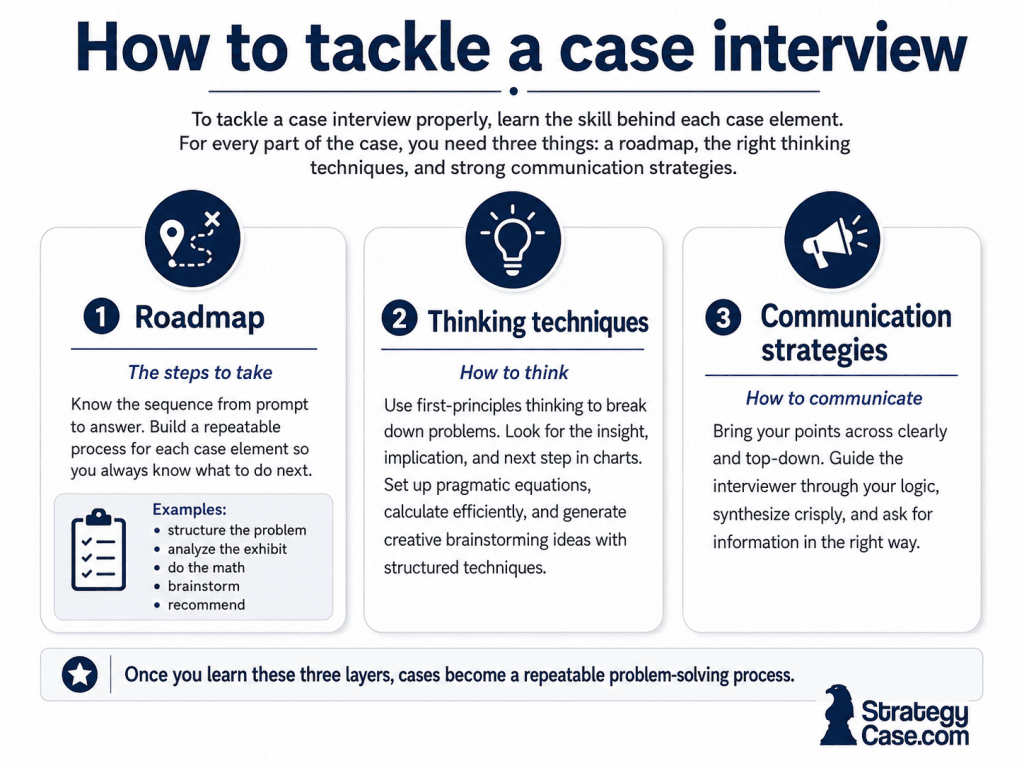
Once you learn these layers, cases stop being random practice rounds and become a repeatable problem-solving process.
How to prepare for a case interview
Most case prep fails the same way: candidates grind 50-plus practice cases chasing a number, mistaking motion for mastery. Modern interviews test specific skills, not memorization or pattern matching, so doing more recycled cases just drills the wrong reflexes.
Build the skill in this order instead:
- Study the theory behind every case interview element. Steps, thinking, and communication.
- Establish your baseline for every element. Find your strongeest and weakest of the five elements. Be honest about whether structuring, math, charts, or brainstorming is dragging you down, then attack that first. Lift your weaknesses, expand your performance spikes.
- Drill the elements separately, with feedback. Build tight structures, run case math under time pressure, and interpret exhibits fast, each as its own exercise before you stitch full cases together.
- Then do full cases out loud with a partner. Quality over quantity: 15 deeply reviewed cases beat 50 rushed ones. Study real case examples to calibrate. Combine peer practice with drills to further work on the individual elements of your performance.
- Prepare the fit interview, because that is how firms run the loop.
- Get honest feedback from someone who has scored real interviews. You (and other students) cannot self-diagnose your blind spots.
Timelines vary by where you start. Most candidates need four to twelve weeks of deliberate practice. For a practice plan, see our case interview preparation plan guide. Experienced hires moving into consulting often need less time on frameworks and more on adapting their thinking to the case format. Candidates from non-business backgrounds should spend more time on each element.
For a structured path through all of this, StrategyCase’s Case Interview Academy covers every element with theory plus thousands of unique practice drills, and 1-on-1 coaching with a former McKinsey and top global case coach is where candidates get the feedback self-study cannot give. If you prefer to start with a book, our ranking of the best case interview books tells you what to read and what to skip.
Don’t forget the fit interview
Every case loop is paired with a fit, or behavioral, interview, and at McKinsey it is the formal Personal Experience Interview (PEI). Firms score it as rigorously as the case, yet most “case interview” content ignores it, which is exactly why so many technically strong candidates get rejected. Prepare distinct stories and narratives, and structure each with a method like SCORE so it lands with stakes and impact instead of rambling.
Frequently asked questions
What is a case interview in simple terms?
It is an interview where you solve a business problem out loud. The interviewer gives you a real-world scenario, like why a company’s users are leaving, and you structure the problem, analyze data, and recommend what the company should do. They are watching how you think, not whether you already know the answer.
How long is a case interview?
A single case runs about 20 to 40 minutes, and it is usually paired with a fit interview in the same 45-to-60-minute session. Across first and final rounds you will typically do four to six interviews in total, each with its own case.
How hard are case interviews and what percentage of people pass?
They are hard because of the bar, not the topics. Fewer than 1 in 100 applicants to top firms ends up with an offer. But it is a trainable skill: the people who pass are the most structured and best prepared, not necessarily the smartest.
How many practice cases do I need to do?
Far fewer than the internet tells you, if you practice the right way. Quality beats volume: 15 to 25 full cases that you review deeply, on top of targeted skill drills, beat 50 rushed cases that just reinforce bad habits. Chasing a case count is the single most common prep mistake.
Can I pass a case interview from a non-business background?
Yes, and firms expect plenty of candidates to. McKinsey, BCG, and Bain actively recruit PhDs, MDs, JDs, and other non-traditional applicants and do not assume prior business knowledge. They assume you can structure an unfamiliar problem and reason through it cleanly, so focus your prep on structuring, exhibit analysis, and math rather than memorizing business theory.
How long should I prepare for a case interview?
Most candidates need four to twelve weeks of deliberate practice, depending on their starting point. That is targeted skill-building against the five core elements plus separate fit-interview prep, with feedback, not a sprint through dozens of cases the week before.
Related guides
- How to get into consulting: the full consulting application and recruiting guide
- How to be MECE in a case interview: the structuring principle behind every strong answer
- The Big 3: McKinsey, BCG, and Bain: how the top firms actually differ
- Dresscode for a case interview: a common question, often overlooked
- The 1%: Case Interview Workbook: self-paced practice with realistic, up-to-date cases
Final word
The case interview rewards a habit most candidates never build: structure the problem before you solve it, then lead the conversation within whatever format the firm uses. Learn the underlying skills for the five elements, prepare against the scored dimensions instead of a case count, and treat the fit interview as the scored half of the loop it actually is.
The process is genuinely tough, fewer than 1 in 100 applicants makes it through, but it is conquerable with the right preparation. Start with StrategyCase’s Case Interview Academy and build the structured, insider-calibrated approach that gets offers at McKinsey, BCG, Bain, and beyond.
About the author: Florian Smeritschnig is a former McKinsey Senior Consultant and the founder of StrategyCase. He spent five years at the firm and has since run more than 2,200 mock case interviews and coached hundreds of candidates into McKinsey, BCG, Bain, and other top firms.
