
Last Updated on September 22, 2026
Updated September 2026. By Florian Smeritschnig, former McKinsey Senior Consultant
Consulting interviews ask four kinds of questions (and give you the chance to ask thoughtful questions too): motivation and fit, behavioral stories, case questions, firm-specific formats such as the McKinsey PEI and the BCG Skills Interview, and the questions you ask them. The list below covers the most common ones. What almost no list tells you is that firms do not score the answer to the question. They score a fixed set of dimensions, and the question or case problem is only the prompt that gets you talking.
That distinction decides offers. Candidates who treat the list as distinct answers to memorize walk in with rehearsed monologues and get cut for sounding rehearsed. Candidates who understand that dimensions sit underneath all prepare far less material and cover far more ground.
Bain says this openly. Its hiring page promises that “any feedback you receive will be based on an objective scoring system, and you can trust that you’ll only be assessed on things that really matter.” That is a rubric, described in public. This guide gives you the questions, what each one is actually scoring, and the follow-up deep dive for each.
Key Takeaways
- Consulting interview questions fall into four types. Most candidates prepare hard for one type, the case, and improvise the other four.
- Firms score dimensions, not answers. McKinsey uses the Personal Experience Interview, Bain states publicly that its feedback runs on an objective scoring system, and BCG’s published process names a separate Skills Interview before the case ever starts.
- In StrategyCase’s own search data, the three questions candidates look up most are not case questions at all. They are “walk me through your resume,” “why consulting,” and “strengths and weaknesses.”
- Roughly 12 stories, properly built, cover every behavioral question on this page. Building 40 separate answers is a common wasted month in case prep.
- The questions you ask at the end are important too. They are the cheapest signal on the list and the one candidates often waste.
What counts as a consulting interview question
Definition: A consulting interview question is any prompt used in a management consulting hiring process to score a candidate against the firm’s rubric. It covers motivation questions, behavioral story questions, business case prompts, and firm-specific formats such as the McKinsey PEI.
Every firm’s process is some arrangement of the same few buckets. The names change, the order changes, and the weighting changes by office and by seniority. The buckets and evaluation criteria do not change.
Here is the map.
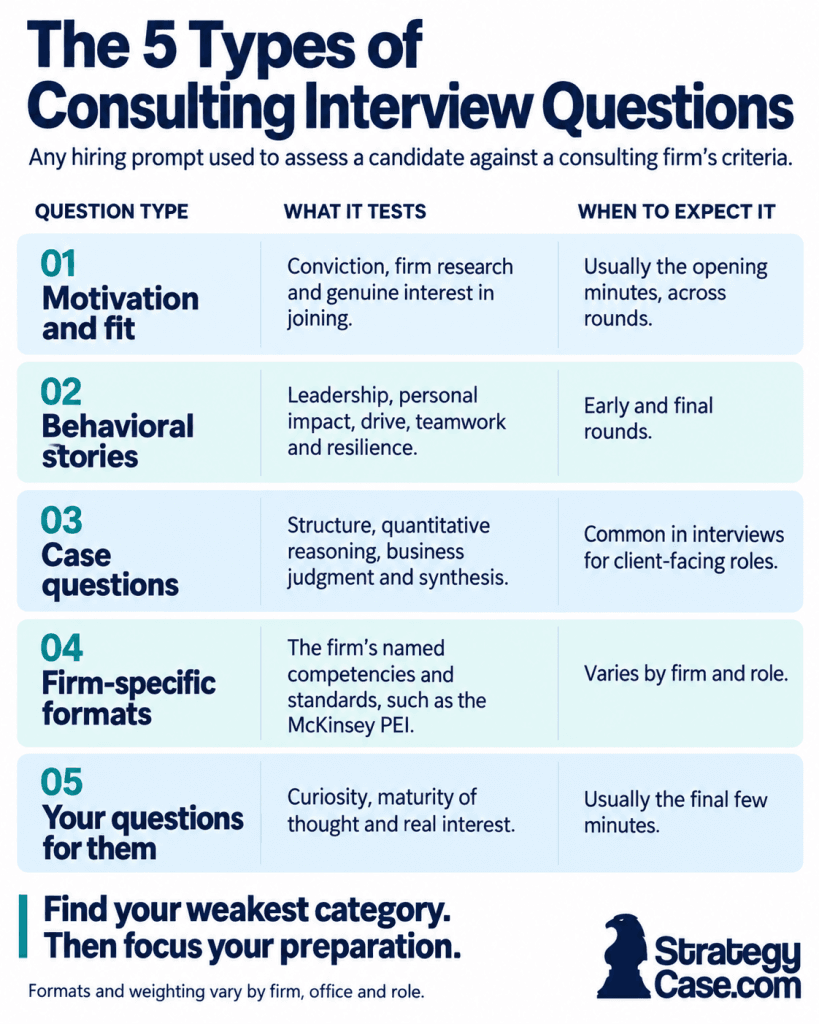
Not sure which of the five is your weak link? That is a diagnosis question, not a practice question, and it is worth answering before you spend another month on undirected case prep.
Motivation and fit questions
Some of these open almost every interview (except for McKinsey) and they are scored on specificity. Anyone can say they want impact and steep learning. The candidate who names a practice, a project type, personal connections, and a reason that could not be copy-pasted to a competitor is the one who scores.
| Question | What it scores | Go deeper |
|---|---|---|
| Tell me about yourself. | Framing, brevity, relevance | Tell me about yourself |
| Walk me through your resume. | Narrative logic behind your choices | Walk me through your resume |
| Why consulting? | Conviction, realism about the job | Why consulting? |
| Why our firm, and not the other two? | Homework, genuine preference | See the firm-specific section below |
| Why this office? | Commitment, local fit, language | Firm-specific |
| What are your greatest strengths and weaknesses? | Self-awareness without self-harm | Strengths and weaknesses |
| Where do you see yourself in five years? | Whether your plan needs this firm | Firm-specific |
| Which other firms are you interviewing with? | Honesty, seriousness of your search | Firm-specific |
| Why should we hire you over the other candidates? | Differentiation under pressure | Firm-specific |
| What will you do if you do not get an offer here? | Maturity, resilience | Firm-specific |
| How do you feel about the travel and the hours? | Realism, staying power | Firm-specific |
Two of these deserve a warning.
“Why our firm” is where tier 2 and Big 4 candidates lose offers they had already won on the case, and where MBB candidates sound interchangeable. If your answer would survive a find-and-replace of the firm name, it scores zero.
“Which other firms are you interviewing with” is not a trap. Interviewers ask it to gauge where you are in your process and how fast they need to move. Answer it straight.
Behavioral and story questions
This is the bucket that decides many final rounds, and the one candidates underprepare. The prompts vary endlessly. The dimensions underneath them barely vary at all.
| Question | Dimension being scored |
|---|---|
| Tell me about a time you led a team toward a difficult goal. | Leadership |
| Describe a time you persuaded someone who disagreed with you. | Personal impact |
| Tell me about a time you failed. | Self-awareness, resilience |
| Describe a conflict inside a team and how you resolved it. | Teamwork, maturity |
| Tell me about a time you delivered under severe time pressure. | Drive, composure |
| Give an example of changing someone’s mind using data. | Analytical persuasion |
| Describe a time you took initiative nobody asked for. | Entrepreneurial drive |
| Tell me about the hardest feedback you have received. | Coachability |
| Describe a decision you made without enough information. | Judgment under ambiguity |
| Tell me about working with someone difficult. | Interpersonal skill |
| What accomplishment are you most proud of, and why? | Values, motivation |
| Tell me about a time you had to change direction fast. | Adaptability |
That is 12 prompts scoring roughly eight dimensions. Which is the whole point.
Build your material around the dimensions and a well-built story can cover three or four prompts at once. A story about turning around a failing project can answer the leadership prompt, the time-pressure prompt, the initiative prompt, and the change-direction prompt, with a different emphasis each time. A few stories genuinely cover this entire bucket.
The structure that makes one story stretch across four prompts is the SCORE framework, and the single most-asked question in the set has its own full breakdown in the guide to leading a group to a difficult goal.
For the full taxonomy of behavioral and motivation questions, including sample answers and the pitfalls that sink them, work through the free consulting fit interview guide.
Case interview questions
Case questions are not really questions. They are business problems, and they come in recognizable shapes. Knowing the shape does not give you the answer, but it tells you which numbers matter and which questions to ask first.
| Case type | Typical prompt | Full guide |
|---|---|---|
| Profitability | Profits fell 20 percent in two years. Why, and what do we do? | Profitability case |
| Market entry | Should our client enter the Brazilian market? | Market entry case |
| Market sizing | How many EV charging points will Germany need by 2030? | Market sizing |
| Growth strategy | How does the client double revenue in three years? | Growth strategy case |
| Mergers and acquisitions | Should our client buy this competitor, and at what price? | M&A case |
| Pricing | How should the client price a newly approved drug? | Pricing case |
| Operations | Plant throughput dropped 15 percent. Find it and fix it. | Operations case |
| Competitive strategy | A new entrant is taking share. How do we respond? | Competitive strategy case |
| Product launch | Should the client launch this product, and how? | Product launch case |
| Turnaround | The client is burning cash and has nine months. | Turnaround case |
| Public sector and non-profit | How should this agency allocate a shrinking budget? | Non-profit case |
| Digital and AI strategy | Where should the client deploy AI, and what is it worth? | Digital transformation case |
| Wildcard | Anything that fits no template at all. | Wildcard case |
Inside any of those 13, the interviewer asks a predictable set of sub-questions (or has you ask them as you investigate the case), and each one scores a different skill:
- “How would you structure this? or What factors would you analyze?” scores structuring. Practice it with our framework structuring guide.
- “What ideas do you have related to X?” scores idea generation under pressure. See brainstorming in a case interview.
- “What do you take from this exhibit?” scores data reading. See interpreting charts and data.
- “To understand X, what do you need to calculate?” scores your quantitative abilities and mental math. See the case interview math guide.
- “The CEO is in the elevator. What do you tell them?” scores synthesis. See the pyramid principle.
- “How many golf balls fit in a 747?” scores comfort with ambiguity. See brainteasers in consulting interviews. Rare these days!
The sub-questions matter more than the case type. A candidate who reads exhibits well and synthesizes cleanly will pass a case type they have never seen. A candidate who has memorized 13 frameworks and cannot do either will fail a profitability case, which is supposedly the easy one.
Before diving into cases, spend five minutes with the case interview feedback sheet first. It shows the dimensions you are actually scored on for the case.
Firm-specific interview formats
Each firm wraps the same five buckets in its own named process, with its own thresholds. Preparing generically for “MBB” is how candidates get surprised in the round that counts.
| Format | Firm | What is different | Full guide |
|---|---|---|---|
| Personal Experience Interview (PEI) | McKinsey | One story, pushed for 10 to 15 minutes on a single dimension | McKinsey PEI |
| Values and purpose questions | McKinsey | Tests alignment with the firm’s stated values, not your resume | McKinsey values interview |
| Technical Expertise Interview (TEI) | McKinsey | For specialists and experienced hires, probes real domain depth | McKinsey TEI |
| Skills Interview | BCG | A named, separate round before the case, covering experience and motivation | BCG fit interview |
| One-way video interview | BCG | Recorded, no interviewer, strict time limits per answer | BCG video interview |
| Experience Interview | Bain | Bain’s take on the traditional fit interview | Bain fit interview |
| Written case | BCG, Bain, others | Document pack, fixed clock, written or presented output | Written case interviews |
The McKinsey PEI is the format that trips people up the most. It is not “tell me about a time.” It is one story, followed by 10 to 15 minutes of increasingly specific questions about what exactly you said, what exactly you were thinking, and what exactly you would change. Stories that sound polished at the two-minute mark fall apart at minute nine, which is precisely what the format is built to find.
McKinsey also now addresses AI use in applications directly on its careers site, alongside what it looks for in candidates. Read what your target firm publishes about its own process before you read anything else. It is free, current, and written by the people scoring you.
Second rounds change the weighting rather than the questions. Partners push harder on motivation and stories and often go lighter on case mechanics, which catches candidates who prepared only for round one. The second-round interview guide covers that shift.
Questions to ask at the end
This part is usually not scored but most candidates waste it on something they could have found on the website.
Good closing questions share one property: only this person, in this role, at this firm, could answer them.
- What does a typical week look like for you right now, on your current project?
- What separates the associates who thrive here from the ones who struggle?
- Which part of the job surprised you most in your first year?
- How has the work you do changed in the last two years?
- What kind of project would I most likely be staffed on first, in this office?
- What is the firm still trying to figure out?
- How does staffing actually work when you want to move into a new sector?
- What was your favorite project?
Avoid anything about pay, hours, or promotion timing at this stage, and avoid anything answered on the careers page. The full guide to closing questions covers how to adapt them by interviewer seniority.
Why memorizing too many answers is the wrong preparation
When I evaluate case interview candidates I do not write down whether the answer is good. I fill in a form against named dimensions, with a score and evidence for each. The question I ask is a way to generate evidence, nothing more.
That has two consequences that should reshape how you prepare.
First, the same story can score several dimensions, and a great story that produces no evidence scores nothing. I have sat through polished, well-delivered answers that I could not score, because the candidate never said what they personally did, what they decided, or what happened as a result. Meanwhile a plain story with specifics scores across three dimensions at once. Delivery is not the currency. Evidence is.
Second, rehearsed answers are visibly rehearsed, and the follow-up questions are where the scoring happens. The first answer is the setup. The four follow-ups are the interview. Candidates who memorize answers have nothing underneath them and start repeating the script in different words. This is the single most common failure mode across the 2,200+ mock interviews and coaching sessions I have delivered.
So the useful version of this page is not 51 answers. It is:
- Ten to twelve real stories, each with specifics, decisions, and outcomes you can defend for 10 minutes.
- One clear motivation narrative that names this firm, this office, and this kind of work.
- Case skill built on the sub-questions (structure, charts, math, synthesis), not on 13 memorized frameworks.
- Four or five closing questions written for the person in front of you.
How to prepare for all question types
A workable order, assuming four to eight weeks:
- Read your target firm’s own process pages first. McKinsey, BCG, and Bain all publish what to expect. Start there, not with a forum thread.
- Build the 10 to 12 stories before you touch cases. They take longer than people expect and they decide final rounds.
- Build case skill from the sub-questions up. Structuring, chart reading, math, and synthesis are trainable separately and transfer to every case type. The comprehensive case interview guide sequences this.
- Practice out loud with someone who pushes back. Follow-up questions cannot be rehearsed alone, which is the thing solo preparation structurally cannot fix.
- Handle the logistics last. The dress code and post-interview thank-you notes take an hour combined and remove two distractions.
The StrategyCase Case Interview Academy covers steps two through four in one structured program, with drills for each sub-question rather than a library of cases to grind through. If the fit and story bucket is your gap specifically, the Fit Interview Masterclass is the targeted version.
Frequently asked questions
What questions are asked in a consulting interview?
Consulting interviews ask four types of question: motivation and fit questions such as “why consulting” and “why our firm,” behavioral story questions about leadership and impact, business case questions, firm-specific formats such as the McKinsey PEI or the BCG Skills Interview (bonus: the questions you ask the interviewer at the end).
How many consulting interview questions should I prepare?
Prepare 10 to 12 stories, one motivation narrative, and four or five closing questions. That covers every behavioral and fit question on this page. Preparing a separate answer for each of the listed prompts is a common wasted month in case preparation, because firms score dimensions rather than answers, and rehearsed material fails at the follow-up questions.
What is the hardest consulting interview question?
For most candidates it is “why our firm, and not the other two.” It is the question with the least available material, it is scored on specificity, and an answer that would survive swapping the firm name scores nothing. The McKinsey PEI is the hardest format, because it pushes a single story for 10 to 15 minutes until unprepared detail runs out.
What questions should I ask at the end of a consulting interview?
Ask questions only this person could answer: what their current week looks like, what separates associates who thrive from those who struggle, what surprised them in year one, and what kind of project you would be staffed on first. Avoid pay, hours, promotion timing, and anything answered on the careers page.
Are consulting fit interview questions the same at McKinsey, BCG, and Bain?
The underlying dimensions are close, but the formats are not. McKinsey runs the PEI, one story pushed hard on a single dimension. BCG runs a separately named Skills Interview covering experience and motivation before the case, and Bain focuses on experiences. Same raw material, three different deliveries.
Do I need different answers for experienced hire interviews?
The questions are the same; the evidence standard is higher. Experienced hires are expected to show real professional impact rather than university leadership, and specialists may also face a technical interview such as the McKinsey TEI. Your stories should come from work, with numbers, stakeholders, and consequences attached.
Related guides
- Case interview examples from McKinsey and others: real cases to work through
- The most common case interview mistakes: what the scoring form actually penalizes
- How to get into consulting: the full application process above these questions
- How long to prepare for consulting interviews: realistic timelines by background
- Case interview success rates by firm: the odds behind the process
The bottom line
The questions on this page are public. Many pages publish a version of the list, and the firms themselves describe their processes openly. The list has never been the scarce thing.
What is scarce is knowing that certain dimensions sit underneath all of them, that the follow-up questions carry the scoring, and that a smaller, better-built pile of material beats many rehearsed answers every time. Prepare the dimensions and the questions take care of themselves. Prepare the questions and you will meet the first follow-up with nothing left.
Pick your weakest of the buckets and start there this week. If you are not sure which one it is, that is the most valuable thing to find out, and it takes one session rather than another month of unguided practice. Book a baseline session with Florian and find out.
About the author: Florian Smeritschnig is a former McKinsey Senior Consultant who spent 5 years at the firm, conducted more than 2,200 interviews, and has coached candidates to 700+ offers at McKinsey, BCG, Bain, and other top firms. He is the founder of StrategyCase.com and the author of three prominent consulting interview and career books.
